2026 Council Nominations

MVMA member nominations for the 2026 MVMA Council are now open. It is an opportunity for members to be a leader in the Manitoba veterinary profession. Licensed members (practicing veterinarians) or members registered under s .17 of the Veterinary Medical Act (registered veterinary technologists) of the MVMA are eligible to nominate colleagues to the MVMA Council.

*Council members can attend meetings via phone or video communications*

The MVMA Council nominations close November 1, 2025.

If you have any questions, please contact Hugh Moran, MVMA Executive Director, at:

executivedirector@mvma.ca or 204-832-1276 ext. 1


The MVMA Council is comprised of six (6) veterinarian members, the past president and two (2) veterinary technologists.

MVMA Council Nominations are open for:

  • veterinarian council members – three (3) year term
  • veterinary technologist council members – two (2) year term


MVMA Election Notification

Should there be more nominations than vacant positions, an election will be held from November 15 to November 30, 2025. The Election Day for 2026 MVMA Council positions (if required), will be December 1, 2025

For more information, click here.


New Policy – Pre-chill microbiological monitoring program for raw poultry

On August 29, 2025, the Canadian Food Inspection Agency (CFIA) has published a new policy titled Pre-chill microbiological monitoring program (PMMP) for raw poultry.

All Safe Food for Canadians (SFC) licence holders who are slaughtering poultry are expected to implement the Pre-chill microbiological monitoring program (PMMP) by December 01, 2025. Currently the scope of this program is limited to poultry carcasses.

For more information, please contact your local CFIA office or email CFIA at CFIA.MeatHygienePrograms-ProgrammesHygieneViandes.ACIA@inspection.gc.ca.

CFIA staff should use the established communication pathways for any questions.


Nouvelle Politique – Programme de surveillance microbiologique avant le refroidissement pour la volaille crue

Le 29 août 2025, l’Agence canadienne d’inspection des aliments (ACIA) a publié une nouvelle politique intitulée Programme de surveillance microbiologique avant le refroidissement pour la volaille crue.

Tous les titulaires d’une licence relative à la salubrité des aliments au Canada (SAC) qui abattent de la volaille sont tenus de mettre en œuvre le Programme de surveillance microbiologique avant le refroidissement (PSMAR) d’ici le 1er décembre 2025. Actuellement, la portée de ce programme est limitée aux carcasses de volaille.

Pour plus d’informations, veuillez contacter votre bureau local de l’ACIA ou envoyer un courriel à l’ACIA à CFIA.MeatHygienePrograms-ProgrammesHygieneViandes.ACIA@inspection.gc.ca.

Le personnel de l’ACIA devrait utiliser les voies de communication établies pour toute question.


As of the date below, the Canadian Food Inspection Agency has declared the following primary control zone (PCZ) and associated Designation and Declaration Orders:

·   September 15, 2025 – AB-IP91 – Sturgeon County, Alberta – commercial, poultry

For more information:

·    Latest bird flu situation

·    Status of ongoing response by province


L’ACIA a déclaré une zone de contrôle primaire pour l’influenza aviaire en Alberta

À partir de la date ci-dessous, l’Agence canadienne d’inspection des aliments (ACIA) a déclaré la zone de contrôle primaire (ZCP) suivante et les ordres de désignation et de déclaration associés :

·  Le 15 septembre 2025 – AB-IP91 – le comté de Sturgeon, Alberta – commerciale, volailles

Pour en savoir plus :

·    Situation actuelle de la grippe aviaire

·    État de réponse en cours aux détections d’influenza aviaire, par province


Update your preferences or unsubscribe / Mettre à jour vos préférences ou vous désabonner


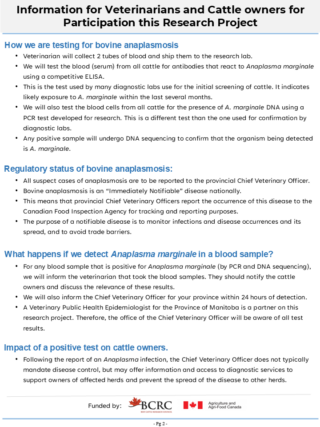
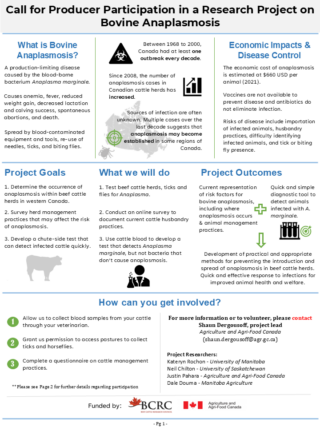
Beef producers and bovine veterinarians are being asked to assist in a western Canadian bovine anaplasmosis study. The study looks to determine the occurrence of anaplasmosis in western Canadian beef cattle, survey herd management practices that may affect the risk of anaplasmosis and develop a chute-side test for rapid detection. The study was unable to collect sufficient samples from beef herds west of Winnipeg last year, so researchers are looking for support and sample submissions again this fall. With preg checking season upon us, bovine practitioners have the opportunity to connect with producers and offer herd screening. The project does provide some compensation for the producer, as well as private veterinarians, for their time.

Those with study questions can contact the project lead with Agriculture and Agri-Food Canada:

Those interested in submitting samples are asked to contact the University of Manitoba team conducting the local diagnostics:


See the study posters here.


The MVMA and MVTA would like to extend our sincere thanks to everyone who participated in the ACER RVT Utilization & Practice Operations Survey. More than 300 people took the time to share their experiences, perspectives, and ideas. This strong level of engagement highlights the commitment within our community to supporting the future of veterinary practice in Manitoba.

Your feedback is invaluable. Each response helps us gain a better understanding of how Registered Veterinary Technologists (RVTs) are being utilized, how practices are functioning, and where there are opportunities to strengthen veterinary teams. This survey marks a significant step toward meaningful change, and it wouldn’t have been possible without your contributions.

To show our appreciation to participants, everyone who completed the survey was entered into a draw for an honorarium. Several individuals were selected to receive $50 Visa gift cards, and one grand prize winner was given the option of an iPad or a $500 Visa gift card. The winners have been contacted directly, and we extend our congratulations to them on receiving these honoraria!

This study is ongoing. The complete survey results and analysis will be published in early 2026. These findings will provide valuable insights and guide efforts to strengthen and support the veterinary profession throughout Manitoba.

ACER Consulting has conducted this study on behalf of the MVTA and MVMA, exploring the current utilization of RVTs in Manitoba, as well as the demand and feasibility of introducing an Advanced Registered Veterinary Technologist (ARVT) role. Alongside the survey, focus groups will be conducted to ensure that diverse perspectives from across the province are represented in the findings. Sign up to participate in our upcoming focus groups and share your valuable insights.

Thank you again for lending your voice to this critical project. Together, we are building a stronger and more sustainable future for veterinary medicine in our province.


Sign up to participate in our upcoming focus groups and share your valuable insights!

ACER Consulting has been commissioned to perform a study on the current utilization of RVTs in Manitoba, as well as the demand and feasibility of introducing an Advanced Registered Veterinary Technologist (ARVT) role within the province. The concerns and needs of the veterinary community and the broader public of a given region can vary greatly. The introduction of an ARVT role has been proposed as a solution for issues of access to care in rural areas or situations where a veterinarian is in short supply. In a separate but related line of inquiry, there is much discussion within the industry that the RVTs who are already on hand are not being utilized to their full potential within the practice setting.

To better understand the economic, workforce, and cultural landscape of veterinary medicine in Manitoba, we launched a survey of veterinarians and RVTs, which is being followed by focus groups and interviews.

We wish to invite you to sign up as a focus group participant. This will be a  60-90 minute virtual meeting hosted over Zoom, where we would like to discuss the issues facing Manitoban veterinary practices – from workforce shortages to implementation – to ensure we move into the next phase of these studies well informed. An honorarium of $100 will be provided in recognition of your time and expertise.

If this is of interest to you, please complete this form to indicate your interest.


The MVMA is currently reviewing a Limited License model as a faster, competency-based pathway to veterinary licensure in Manitoba. This approach would allow veterinarians to practice specifically within their demonstrated area of expertise. For example, a small animal veterinarian would remain focused on small animal medicine.

Since 2022, MVMA Council has been engaged with a national pilot project designed to test and validate this model. The pilot demonstrated strong potential to support safe, targeted licensure and improve access to veterinary services across Manitoba. Before this pathway can be implemented in the province, it will require a bylaw change and a formal member vote. The MVMA is committed to keeping members informed and engaged throughout this process.

The pilot project, known as the Limited Licensure Competency Assessment Pathway (LLCAP), was launched by the Canadian Council of Veterinary Registrars with support from the Canadian Veterinary Medical Association’s Workforce Shortage Project. It was developed in response to Canada’s growing veterinarian shortage. Traditional licensing demands broad expertise across species, which can block internationally educated vets with focused, advanced experience.

The LLCAP offers a practical alternative. It assesses internationally trained vets with specialties in production animals, small companions, or equine practice. It lets candidates earn limited licensure based on proven skills instead of standardized exams.

The pilot’s goal was simple: build and test a competency-based model that stands as a solid, sustainable alternative. Candidates submit a portfolio demonstrating their skills and then complete supervised practice in real-world settings under assessor guidance. The process aligns with the 2022 North American Essential Competency Profile for Veterinary Medicine.

22 candidates entered; 17 advanced to supervised practice. The portfolio submission process played a crucial role in identifying competency gaps and helping candidates understand the expectations of supervised practice. Key insights emerged during supervised practice, particularly around clinical decision-making and adaptability. 12 candidates successfully passed this phase.

The report includes recommendations to sharpen the pathway’s reliability and usability. Design choices prioritize defensible assessment outcomes, fit for experienced professionals, and capable of drawing sound conclusions on candidate competence.

In short, the LLCAP pilot confirmed that a competency-based approach is effective and practical for limited licensure. Real-world assessments deliver meaningful results. With improvements in assessor consistency, candidate readiness, and process standardization, this pathway is poised for expansion.

To see the LLCAP executive summary, please click here.


The MVMA is excited to share that Barb Kryzanowski will assume the role of Interim Registrar effective July 23, 2025. Barb has served as Deputy Registrar since 2021 and brings more than a decade of experience in professional regulation. Since 2013, she has played a key role in advancing regulatory initiatives at both the provincial and national levels. Barb’s experience, steady leadership, and deep understanding of the veterinary regulatory environment position her well to guide the MVMA through this transitional period.

Barb can be reached at barbk@mvma.ca.

We are also pleased to welcome Hugh Moran as Interim Executive Director, effective August 15, 2025. Hugh brings over 30 years of provincial and federal experience in association leadership. He has led organizations through governance renewal, strategic planning, and operational change, and has built strong relationships across government, industry, and professional communities. His collaborative, forward-thinking approach will support the MVMA’s ongoing work and strategic priorities.

Hugh can be reached at executivedirector@mvma.ca.

We are confident in Barb and Hugh’s leadership and are well prepared to ensure a smooth transition as they step into their interim roles. The MVMA remains focused on continuity, progress, and service to the profession throughout this period.


The Chief Veterinary Office (CVO), in collaboration with industry stakeholders and the Canadian Food Inspection Agency (CFIA), would like to inform MVMA members that a case of bovine tuberculosis (BTb) has been confirmed in a seven-year-old animal that was slaughtered at a federally inspected abattoir in Manitoba. As with other federally reportable diseases, the investigation is led by the CFIA, with support from the CVO and industry stakeholders. A national eradication program mandated by the CFIA has been in place for BTb since 1923, which involves a quarantine being placed on the farm that the infected animal originated from and BTb testing of this herd will occur prior to depopulation. Contact tracing conducted by the CFIA will determine if additional herds pose a risk and also undergo BTb testing.

Manitoba Public Health has been notified of the detection and oversees the human health aspect of BTb. Veterinarians are reminded and encouraged to share with clients that although BTb is zoonotic, the pasteurization of milk destroys Mycobacterium bovis and the surveillance system in place at slaughter facilities ensures food safety within Canada.

Veterinary teams can find further information concerning BTb at the CFIA’s Bovine Tuberculosis website or Bovine Tuberculosis Investigations website. They may also reach out to the CVO, chiefveterinaryoffice@gov.mb.ca or 1-204-945-7663, with any questions.

Manitoba veterinary clinics are also reminded that special mental health resources are available to livestock producers and those involved in agriculture. Veterinary teams are encouraged to share this information with clients, as no one should feel alone when they are struggling. The Manitoba Farmer Wellness Program (MFWP) offers no-cost, short term counselling specifically tailored to Manitoba farmers, farm families and farm employees. The Canadian Centre for Agriculture Wellbeing (CCAW) offers mental health training to those involved in the agricultural industry. The National Farmer Crisis Line, 1-866-FARMS-01, offers free, 24/7 mental health support to farmers, farm families and agricultural workers in Canada.

MVMA full colour-01

ABOUT THE MVMA

Mission: To protect the public through the regulation of veterinary medicine, to support our members and to promote the profession in Manitoba.

Vision: A sustainable veterinary community working together to prioritize the health and welfare of animals, people and the environment.

Equity, Diversity and Inclusion Statement: The MVMA is committed to equity, diversity and inclusion across gender identity, ethnicity, religion, age, neurodiversity, physical or mental ability, sexual orientation, and marital status. The MVMA membership is multicultural and we value multiple approaches and different points of view in a safe, positive and collaborative environment.

INFORMATION

Become an MVMA Member – Learn about the requirements to become a licensed veterinarian or registered veterinary technologist.

Veterinary Medicine – Find out how veterinary medicine impacts the lives of animals.

©2019 MVMA. All rights reserved.