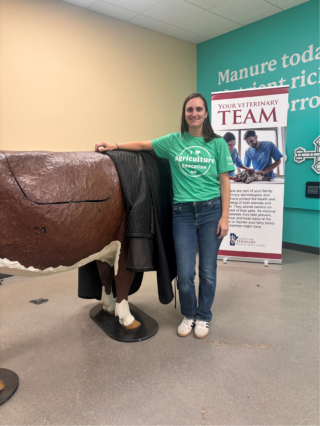
A huge thank you to the MVMA members who volunteered at Agriculture in the Classroom Manitoba’s Amazing Ag Adventure this September!

Drs. Leo Kenny, Keri Hudson-Reykdal, Melissa Desrochers and Marg Seward, along with RVT Jordan Kondratiew, helped introduce 1,000 students from 41 classrooms to the world of animal health and veterinary medicine over four exciting days.

For many students, this event provides a unique opportunity to learn about animals, explore the important role veterinary professionals play in animal and human health, and discover potential careers in veterinary medicine.

These hands-on experiences can leave a lasting impression, sparking curiosity and inspiring the next generation of veterinary professionals in Manitoba.

Thank you to our dedicated volunteers for generously sharing your time, knowledge and enthusiasm. Your contributions help build awareness of the veterinary profession and inspire future generations!

Pictured: Dr. Stephani McLean and Clover helping students discover the many ways veterinarians contribute to animal and human health.


The MVMA Council is seeking your input on several important matters that may result in proposed bylaw changes being brought forward for consideration at the 2027 MVMA Annual General Meeting (AGM), to be held January 29, 2027, at 7:00 p.m.

In accordance with the MVMA Consultation Policy, Council believes that meaningful consultation with members is an essential part of the bylaw development process. Consulting with the membership before proposals are finalized provides an opportunity to consider different perspectives, identify practical considerations and potential unintended consequences, and ensure that proposed changes appropriately reflect the needs of the public and the profession we serve.

The current consultations are as follows:

  1. Proposed Amendment to meet Procedure Rules – Consultation closed November 23
  1. Veterinarian licensure and registration rules – Consultation is now closed
    • Consultation on Supervision Requirements for Restricted Veterinarians Following the Discontinuation of the Preliminary Surgical Assessment (Consultation Document )
    • Consultation: Proposed Bylaw Amendments for Graduates who have not yet Successfully Completed the NAVLE (Consultation Document)
    • Consultation: Proposed By Law Amendments to Enable Limited Licensure via the Limited Licensure Competency Assessment Pathway (Consultation Document)
    • Consultation: Proposed Changes to the Registration and Licensure Framework for Veterinarians (Consultation Document)


  1. Amendments to the newly adopted PIPS Bylaw – Consultations is now closed


Your Feedback Matters

The MVMA Council appreciates the time and consideration members invest in reviewing these proposals. This consultation is an important step in ensuring that Council has the benefit of members’ experience and perspectives before determining which changes, if any, should proceed to the 2027 AGM.

Following the consultation process, Council will consider the feedback received and determine which proposals should proceed to the 2027 AGM.

We encourage all members to take the time to review the consultation materials and share their perspectives.

Thank you for your continued engagement with the MVMA and for contributing to the ongoing development of the profession and its regulatory framework.

Sincerely,

MVMA Council
Manitoba Veterinary Medical Association


Vetavision is a biennial, student-run event that invites school groups, prospective veterinary students and people of all ages to explore the world of veterinary medicine, animal health and public health at the WCVM’s largest public event. The two-day event will take place from September Friday 25th and Saturday 26th, 2026, and will be open to the public from 9 a.m. to 7 p.m. each day. Vetavision will take place in and around the WCVM’s facilities located on the University of Saskatchewan (USask) campus in Saskatoon, SK. For more information about the event, please visit the Vetavision 2026 website.

Vetavision 2026 is a not-for-profit event that is 100 percent organized and operated by veterinary students at the WCVM. Proceeds from the event primarily go toward the purchase of materials for over 25 interactive booths and the support of animal care costs for the event.

As a Vetavision sponsor, your organization will be recognized as a valuable partner in a highly popular public event that attracts thousands of visitors from across Saskatchewan.

Sponsorship opportunities close Thursday, September 10

Please review the Vetavision 2026 information and sponsorship package for details. Sponsorship packages can be completed electronically and returned to either of these email addresses (jnq604@usask.ca or nrk981@usask.ca).

This can be a great opportunity to give back to your community and advertise to veterinary students.


With inflation currently sitting at 4%, how will wages stack up this year?

Tell us your story in this year’s Survey of Compensation and Benefits for Associate Veterinarians.

Results from the survey can help you:

  • Negotiate a fair compensation and benefits package.
  • Better understand compensation trends and your current market value.
  • Compare your personal work experience to other associate veterinarians.

Associate, locum and new graduate veterinarians are invited to participate, as well as those veterinarians employed in alternate career paths like government, industry, and academia. By completing the survey, you’ll have the chance to enter into a draw for a chance to win one of two prizes:

  • $500 prepaid gift card; or,
  • complimentary registration to the 2027 CVMA Convention

Members of the Manitoba Veterinary Medical Association (MVMA) also have a chance to win a $125 prepaid gift card.

Deadline to participate in the survey is September 8th.


The Manitoba Chief Veterinary Office (CVO) and industry partners would like to remind mixed animal veterinary teams that swine diseases more commonly found in commercial production systems have the potential to also affect smaller scale swine operations and pet pig properties. A recent Porcine Epidemic Diarrhea virus (PEDv) detection in a smaller commercial operation likely occurred when a producer came in contact with the disease at a provincial slaughter facility.

For those less familiar with the swine industry, PEDv is a highly transmissible viral disease that causes significant economic and animal welfare impacts. The disease is an ongoing risk in the swine industry, with high traffic commercial sites, such as assembly yards where cull sows are collected and large slaughter facilities receiving sows from outside of Manitoba, often test PCR positive on environmental sampling. Although PEDv can infect all production stages of swine, young piglets are the most heavily impacted and high levels of mortality are usually experienced in 7–10-day old piglets. Other signs noted in infected pigs include vomiting, diarrhea, and dehydration. Pig owners are encouraged to discuss practical disease prevention (biosecurity) plans tailored to their unique farm system or yard with their herd veterinarian. Veterinarians with questions about PEDv or biosecurity for small holder swine and mixed animal veterinary clinics are welcome to reach out to the CVO at chiefveterinaryoffice@gov.mb.ca or 1-204-945-7663.


Date: June 12, 2026

Manitoban veterinary professionals are advised of rising cases of New World screwworm (NWS) in Mexico and the United States. As of June 11, 2026, eight cases have been confirmed in Texas (6 cattle, 2 goat cases), and one case in a dog from New Mexico. These mark the first detections of NWS in the United States since 2016.


What is New World Screwworm?

NWS is a parasitic fly (Cochliomyia hominivorax) endemic in South America and many Caribbean countries. During the larval stage, maggots eat the living flesh of their warm-blooded host causing significant tissue damage and creating opportunities for secondary bacterial infections. If left untreated, an infestation of NWS can be fatal.

• Any animal or person with an open wound is at increased risk of contracting NWS.
• Livestock is at highest risk of infestation, especially at the umbilicus and wounds from dehorning and castration. NWS can also infest wildlife, pets, occasionally birds, and people.
• In Canada, NWS is a federal immediately notifiable disease.
• The USA eradicated NWS in 1966, and use of the Sterile Insect Technique created a barrier zone at Panama’s Darién Gap between Central and South America. The barrier failed in 2023, and NWS re-emerged in Mexico in late 2024.
• The Centers for Disease Control and Prevention (CDC) reports more than 170,000 cumulative cases of NWS in animals in Mexico and Central America, and more than 2000 cases in humans. Sustained, year-round transmission of the fly life cycle requires regular daily air temperatures between 25°C and 30°C and a relative humidity of 30% to 70%.
• While most regions in Canada are considered very low risk for the establishment of NWS, localized cases and seasonal establishment are still a risk to animal health and could trigger potential trade impacts if NWS was detected in Canada.


Import Restrictions for Livestock

On June 5, 2026, the Canadian Food Inspection Agency (CFIA) issued a news release announcing temporary import restrictions for livestock, including horses, from the State of Texas.

• Livestock/horses will not be permitted into Canada if they have been in Texas at any time within the previous 21 days.
• Livestock/horses from Texas are required to reside in another state for a minimum of 21 days before entry into Canada would be permitted.
• Strict import restrictions on livestock/horses remain in place for Mexico.

For additional information on livestock import requirements, see the Automated Import Reference System (AIRS) or contact your local CFIA district office.


Companion Animal Context

There are currently no import restrictions for companion animals moving into Canada from areas impacted by NWS.

• There have been over 3000 canine cases reported since the current outbreak in Mexico began in November 2024.
• As of June 8, 2026, there are currently 662 active cases of NWS in dogs in Mexico.
• Dogs present a potential risk factor for entry of NWS into Canada that may lead to temporary transmission pathways, and significant impacts to other animals and people.
• Both Credelio/Credelio CAT and NexGard/NexGard Combo are effective extra-label in cats and dogs at killing the larval stage of NWS.


Recommendations for Veterinary Professionals

• Clinical signs of NWS include swellings, foul odor, unresolving wounds, and visible burrowing maggots. Infestations with NWS (myiasis) can be very deep with secondary infections that can be fatal if untreated.
• In livestock, wounds may be in discrete locations that are not easily observed. It can also be difficult to detect infested wounds in heavy coated dog and cat breeds.
• Report any suspected cases to the CFIA, especially if there is a history of travel, and save maggots for confirmatory testing.
• Treatment includes physical removal of maggots and wound debridement. Remove all larvae and place them in 70% ethanol to kill them (never throw them outside or in the trash). It is critical that the larvae do not drop to the soil where they can complete their life cycle.
• Injectable ivermectin and doramectin may be given extra-label in livestock/horses under veterinary supervision. Topical products including F10 Antiseptic Wound Spray with Insecticide may also be considered extra-label. Other drugs including but not limited to Negasunt Powder may be available under emergency drug release. In the event of a NWS detection, treatment options would be advised by the CFIA in consultation with the Veterinary Drugs Directorate (VDD).
• Isoxazoline-based oral products have efficacy for both prevention and treatment in cats and dogs.
• Recommend and prescribe Credelio or NexGard for cats and dogs travelling from warm climates 24 hours prior to re-entry into Canada with a follow up dose in 30 days.
• Discuss potential implications for clients travelling to Mexico or Texas with livestock, horses, and pets.


Summary

NWS is a serious and life-threatening myiasis-causing parasitic fly that can infest both animals and people. Rising cases of NWS in Mexico and the State of Texas highlight the potential risk factors for disease incursion into Canada. Veterinarians remain a first line of defense to combat animal health and public health threats including but not limited to NWS. Preventative ectoparasitic treatment options remain readily available for companion animals travelling or entering Canada from warm climates.


For further information or guidance, veterinarians may contact their local CFIA district office or the office of the provincial Chief Veterinarian at 204-945-7663.

For more information on NWS and the current situation in the United States visit:
• New World Screwworm Confirmed Detections Dashboard | USDA APHIS
• Emergency Response NWS | USDA Animal and Plant Health Inspection Service
• Screwworm.gov | Unified Government Response To Protect the United State


CANCELLED

After careful consideration, the Manitoba Veterinary Medical Association has made the difficult decision to cancel this year’s event. While we were looking forward to bringing together veterinary students and Manitoba’s veterinary community, we were unable to secure sufficient participation from veterinary professionals to deliver the meaningful networking, mentorship, and connection opportunities we had planned.

We sincerely appreciate the support of our hosts, partners, veterinary professionals, and students who expressed interest in being part of this initiative. We remain committed to creating opportunities that support veterinary students and strengthen connections within Manitoba’s veterinary community.

NextGen Vets: Summer Student Days 2026

Building Connections and Knowledge for Future Veterinary Leaders

July 16–17 | Winnipeg & Stonewall

Please note: NextGen Vets: Summer Student Days 2026 has been cancelled.


Student Networking Mixer

Thursday, July 16, 2026
6:00 PM to 9:00 PM
Local Public Eatery, Garry Street, Winnipeg

What to Expect

Join us for an evening of great food, relaxed conversation, and valuable networking. Meet practicing veterinarians, registered veterinary technologists, clinic managers, and fellow students in a casual atmosphere.

For Students

Student registration is free and includes food and non-alcoholic beverages. This is an opportunity to ask questions, learn about different career paths, and meet professionals from clinics across Manitoba.

For Veterinary Professionals

Each practice may register up to two representatives. Meet veterinary students before graduation, share your experiences, and introduce your clinic to the next generation of veterinary professionals.

Please Note

We’ll be there to welcome you starting at 6:00 PM, which is when we have access to the venue. When you arrive, stop by the welcome table to pick up your name tag before joining the event. There is no formal networking schedule, so you’re free to mingle at your own pace and enjoy the evening. Hailey will be available throughout the event if you have any questions or need assistance.

Student Registration – CLOSED

Professional Registration – CLOSED


Bison and Elk Farm Tours

Friday, July 17, 2026
Stonewall, Manitoba

What to Expect

Continue your NextGen Vets experience with a behind-the-scenes look at a unique livestock operation in Manitoba. Learn about herd health, production practices, and the role veterinarians play in caring for bison while connecting with fellow students and professionals.

Included with Your Registration

  • Guided tour of Rockwood Bison Ranch
  • Informal Q&A

Please Note:

A visit to Elk Ranch is currently to be determined. If this additional stop is confirmed, the tour schedule will be updated accordingly, and the event will likely conclude at 12:30 PM instead of 11:30 AM. Updated itinerary details will be shared with all registered participants as soon as they are confirmed.


Registration – CLOSED


Questions?

Contact: engagement@mvma.ca


The MVMA is seeking veterinarians and registered veterinary technologists to volunteer at Ag in the Classroom Manitoba’s Amazing Ag Adventure, taking place September 22 to 25, 2026, at the Bruce D. Campbell Farm & Food Discovery Centre.

This annual event introduces students to Manitoba agriculture and the many career opportunities within the industry. Over four days, approximately 1,000 students from Grades 3 to 12 will participate in hands-on learning experiences, including a visit to the veterinary medicine station hosted by the MVMA.

Volunteers will help engage students as they explore veterinary medicine through interactive displays and activities. The station will feature Clover, 4-H Manitoba’s demonstration calving cow, along with calving equipment, microscope demonstrations, and other veterinary learning tools. Volunteers who are comfortable discussing calving and livestock health are especially encouraged to participate.

This is a rewarding opportunity to inspire young people, share your passion for veterinary medicine, and help students connect with agriculture in a meaningful way.

Event Details

Location: Bruce D. Campbell Farm & Food Discovery Centre (Glenlea Research Station)

Dates: September 22 to 25, 2026

Student Tour Hours: 10:00 a.m. to 2:00 p.m.

Volunteer Commitment: Approximately 9:00 a.m. to 2:00 p.m.

Lunch will be provided.

We are looking for two to three volunteers per day. Whether you can help for one day or multiple days, your support is greatly appreciated.

To volunteer or learn more, please contact Deanne.Wilkinson@gov.mb.ca


Following the 2026 Annual General Meeting, a new requirement has been approved under the PIPS By-law regarding the appointment of a Responsible Veterinarian.

This provision will come into force on a date to be determined by resolution of the MVMA Council. To support a smooth transition and ensure compliance upon enactment, all veterinary practices are required to appoint a Responsible Veterinarian and submit the required appointment form to the MVMA by (suggested date of  Nov 1)

Submission Requirement
Each veterinary practice must complete and submit the Responsible Veterinarian Appointment Form to formally designate their Responsible Veterinarian. This step is mandatory and required to be compliant with the newly approved PIPS By-law.

Practices are strongly encouraged to begin identifying their Responsible Veterinarian now to avoid delays in compliance.

What is a Responsible Veterinarian?
A Responsible Veterinarian is a veterinarian with an unrestricted licence who is formally appointed by the practice owner or owners to oversee the operation of the veterinary practice.

This individual holds overall authority for the practice and is expected to be informed about all aspects of its operations. They provide overall guidance to ensure the practice complies with the Act, the By-laws, and all applicable Guidelines, and serve as the primary decision-maker for operational matters.

The Responsible Veterinarian is also responsible for signing and confirming the accuracy of all PIPS documents submitted to the MVMA. The name of the Responsible Veterinarian for each veterinary practice will be published by the MVMA.

Practice Inspection and Practice Standards By-law (PIPS) By-law Requirements (Section B.2)
Each veterinary practice must appoint an unrestricted registered veterinarian to act as the Responsible Veterinarian. The appointed individual must:

  • Be registered as a General Veterinarian Member
  • Be familiar with the statutory requirements for operating a veterinary practice
  • Ensure the practice meets all applicable standards of practice

The Responsible Veterinarian does not assume responsibility for the conduct of other members working within the practice. All veterinarians and veterinary technologists remain individually responsible for meeting professional competency and conduct standards.

A veterinarian is not eligible to act as a Responsible Veterinarian if:

  • They are no longer registered as a General Veterinarian Member
  • Conditions or restrictions are placed on their licence
  • Their licence is suspended

If a Responsible Veterinarian resigns or becomes ineligible, the practice must appoint a new Responsible Veterinarian within 30 days. Failure to do so will result in the practice being prohibited from providing veterinary services until:

  • A new Responsible Veterinarian is appointed, and
  • An inspection has been completed


For questions or further information, please contact mvmainfo@mvma.ca


The Manitoba Veterinary Medical Association (MVMA) is aware that human pharmacies, including large retail pharmacies such as Costco, are dispensing veterinary-only prescription medications, including seasonal heartworm and tick prevention.

The regulation of human pharmacies, including their scope of practice and dispensing activities, falls under the jurisdiction of the College of Pharmacists of Manitoba.

The Pharmaceutical Act defines prescription as:

“prescription” means a direction given by a practitioner directing that a stated amount of a drug specified in the direction be dispensed for the person named or animal described in the direction.

Under the current legislative and regulatory framework in Manitoba, human pharmacies that are appropriately licensed and operating within their scope may dispense veterinary prescriptions. The MVMA does not have the authority to regulate or restrict the dispensing activities of human pharmacies.

While similar practices have been reported in other Canadian jurisdictions, regulatory requirements are determined at the provincial level. There have been no changes to MVMA by-laws or expectations for members

Current Requirements and Guidance

As per MVMA General By-Law No 1:

Provide prescription on request

4-6-6 Where a VCPR exists, the Practicing Veterinarian Member must, upon request by the client, provide to a client a prescription instead of dispensing the prescription product.

As per section 2.6.3.3 of the MVMA PIPS By-Law All prescriptions must contain the following information:

i. Date
ii. Client
iii. Animal or group
iv. Drug–including generic name and strength
v. Direction for use–dosage, route, frequency, duration, withdrawal times
vi. Quantity
vii. Refills

If you have been asked to provide the prescription to a pharmacy directly, ensure that the pharmacy is properly registered in Manitoba. All practices that offer pharmacy services through The Veterinary Medical Act are required to hold a Practice Inspection Practice Standards (PIPS) Certificate. All practices in Manitoba that hold a PIPS Certificate are listed on the MVMA website on the Veterinary Practices Database.

All human focused pharmacies in Manitoba are regulated by the College of Pharmacists of Manitoba. A public register of pharmacies in Manitoba is available here. More information about human pharmacies can be obtained by contacting the College of Pharmacists of Manitoba.

The MVMA rules require you to provide a prescription when requested. If you are unable to confirm if a pharmacy is registered in Manitoba, you can provide your client with a written prescription for them to fill themselves.

The MVMA by-laws do not prohibit veterinarians from charging a reasonable prescription administration or processing fee. Decisions regarding such fees are at the discretion of each veterinary practice. However, regardless of such fee, a prescription must be provided upon request.

Continuity of Care and Professional Responsibility

This situation raises broader considerations related to continuity of care, patient safety, and appropriate oversight in the prescribing and dispensing of veterinary medications.

Veterinarians remain responsible for ensuring that prescriptions are clinically appropriate and supported by a valid VCPR. Clear communication with clients regarding treatment plans, product use, and follow-up care continues to be essential, regardless of where a prescription is filled.

The MVMA recognizes that members have raised concerns regarding continuity of care, product sourcing, prescribing oversight, and the broader impact on veterinary practice sustainability. The MVMA is developing an advocacy approach on behalf of the profession and will continue engaging with relevant stakeholders regarding these concerns.

If you have concerns about the care received at a pharmacy or the conduct of a pharmacist, please contact the College of Pharmacists of Manitoba .


Practice guidance information is available on the MVMA website:

https://www.mvma.ca/wp-content/uploads/2022/05/written-prescriptions-guidance-doc.pdf

MVMA full colour-01

ABOUT THE MVMA

Mission: To protect the public through the regulation of veterinary medicine, to support our members and to promote the profession in Manitoba.

Vision: A sustainable veterinary community working together to prioritize the health and welfare of animals, people and the environment.

Equity, Diversity and Inclusion Statement: The MVMA is committed to equity, diversity and inclusion across gender identity, ethnicity, religion, age, neurodiversity, physical or mental ability, sexual orientation, and marital status. The MVMA membership is multicultural and we value multiple approaches and different points of view in a safe, positive and collaborative environment.

INFORMATION

Become an MVMA Member – Learn about the requirements to become a licensed veterinarian or registered veterinary technologist.

Veterinary Medicine – Find out how veterinary medicine impacts the lives of animals.

©2019 MVMA. All rights reserved.